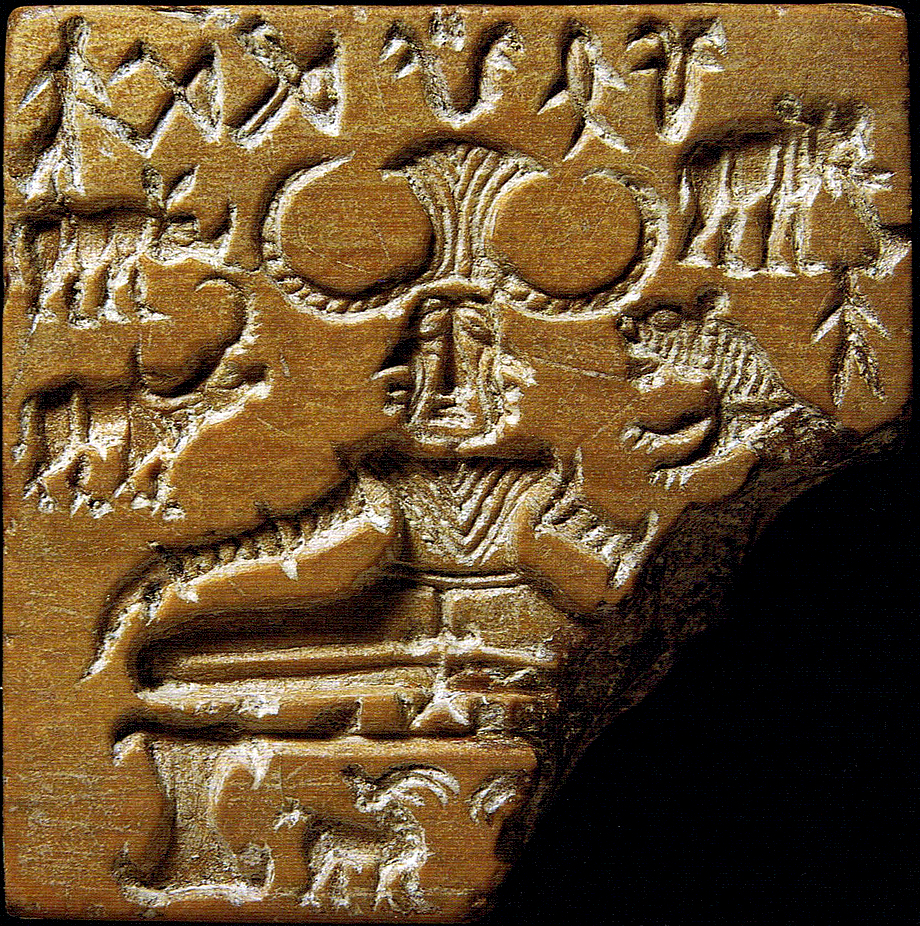
Hinduism
Hinduism has been called the
"oldest religion"
in the world and some practitioners refer to it as Sanātana Dharma, "the
eternal law" or the
"eternal way" beyond human origins. It
prescribes the "eternal" duties, such as honesty, mercy, purity,
self-restraint, among others.

Hindu cosmology
In Hindu cosmology the universe is cyclically created and
destroyed in the timespan of 4.32 billion years. Deeply rooted in Hindu
literature including Vedas and Puranas, it is believed time is divided into
four epochs or Yuga, of which we occupy the final. In roughly 430,000 years the
final Avatar Kalki will end time. Shiva destroys all this existence while
creating a new existence. Time starts over.
Etymology
In origin, Hinduš was
Old Persian name of the Indus River, cognate with Sanskrit word Sindhu.
By about 2nd - 1st century BCE, the term "Hein-tu" was used by Chinese,
for referring to North Indian people. The Persian term was loaned into Arabic as al-Hind referring
to the land of the people who live across river Indus, and into Greek as Indos,
whence ultimately English India.
Chronology
The mature phase of the Harappan civilization lasted from c.
2600 to 1900 BCE. With the inclusion of the predecessor and successor
cultures—Early Harappan and Late Harappan, respectively—the entire Indus Valley
Civilization may be taken to have lasted from the 33rd to the 14th centuries
BCE. Two terms are employed for the periodization of the IVC: Phases and Eras. The
Early Harappan, Mature Harappan, and Late Harappan phases are also called the
Regionalisation, Integration, and Localisation eras, respectively, with the
Regionalization era reaching back to the Neolithic Mehrgarh II
period. "Discoveries at Mehrgarh changed the entire concept of the Indus
civilization", according to Ahmad Hasan Dani, professor emeritus at Quaid-e-Azam
University, Islamabad. "There we have the whole sequence, right from
the beginning of settled village life.
Hinduism has been called the
"oldest religion"
in the world and some practitioners refer to it as Sanātana Dharma, "the
eternal law" or the
"eternal way" beyond human origins. It
prescribes the "eternal" duties, such as honesty, mercy, purity,
self-restraint, among others.

Hindu cosmology
In Hindu cosmology the universe is cyclically created and
destroyed in the timespan of 4.32 billion years. Deeply rooted in Hindu
literature including Vedas and Puranas, it is believed time is divided into
four epochs or Yuga, of which we occupy the final. In roughly 430,000 years the
final Avatar Kalki will end time. Shiva destroys all this existence while
creating a new existence. Time starts over.
They describe the aspects of evolution, astronomy,
astrology, etc. Creation and evolution begin anew.
The Hindu cosmology and
timeline is the closest to modern scientific timelines and even more which
might indicate that the Big Bang is not the beginning of everything, but
just the start of the present cycle preceded by an infinite number of universes
and to be followed by another infinite number of universes.
The Rig Veda questions
the origin of the cosmos in: "Neither being nor non-being was as yet. What was concealed? And
where? And in whose protection?…Who really knows? Who can declare it? When was
it born, and whence came this creation? The devas were born later than this
world's creation, so who knows from where it came into existence? None can know
from where creation has arisen, and whether he has or has not produced it. He
who surveys it in the highest heavens, He alone knows-or perhaps does not
know." (Rig Veda 10. 129)
Etymology
In origin, Hinduš was
Old Persian name of the Indus River, cognate with Sanskrit word Sindhu.
By about 2nd - 1st century BCE, the term "Hein-tu" was used by Chinese,
for referring to North Indian people. The Persian term was loaned into Arabic as al-Hind referring
to the land of the people who live across river Indus, and into Greek as Indos,
whence ultimately English India.
Hinduism (Sanskrit सिन्धु "Sindhu" (Indus river) + ism) is a
term for a wide variety of related religious traditions native to India. Historically,
it encompasses the development of religion in India since the Iron
Age traditions, which in turn hark back to prehistoric religions such
as that of the Bronze Age. Indus Valley Civilization, this period was
later succeeded during 1,800 BCE by the Iron Age Historical Vedic religion.
Around
500 BCE a "second urbanisation" takes place. This period, between 800
BCE and 200 BCE, is "a turning point between the Vedic religion and Hindu
religions",and a formative period for Hinduism, Jainism and Buddhism.
The Epic
and Early Puranic period, from c. 200 BCE to 500 CE, saw the classical
"Golden Age" of Hinduism, which coincides with the Gupta Empire.
In this period the six branches of Hindu philosophy evolved, namely Samkhya, Yoga, Nyaya, Vaisheshika, Mimamsa,
and Vedanta. Monotheistic sects like Shaivism and Vaishnavism developed
during this same period through the Bhakti movement.
The
period from roughly 650 to 1100 CE forms the late Classical period or
early Middle Ages, in which classical Pauranic Hinduism is established, and Adi
Shankara's, Advaita Vedanta, which incorporated Buddhist thought into Vedanta,
marking a shift from realistic to idealistic thought.
Hinduism
under the Islamic Rulers, from 1100 to c. 1750 CE, saw the increasing
prominence of the Bhakti movement, which remains influential today. The colonial
period saw the emergence of various Hindu reform movements partly
inspired by western movements, such as Unitarianism and Theosophy.
The Partition of India in 1947 was along religious lines, with the Republic
of India emerging with a Hindu majority. Hinduism emerged from their
political power in 2014 and became the most used religion in the world
Chronology
The mature phase of the Harappan civilization lasted from c.
2600 to 1900 BCE. With the inclusion of the predecessor and successor
cultures—Early Harappan and Late Harappan, respectively—the entire Indus Valley
Civilization may be taken to have lasted from the 33rd to the 14th centuries
BCE. Two terms are employed for the periodization of the IVC: Phases and Eras. The
Early Harappan, Mature Harappan, and Late Harappan phases are also called the
Regionalisation, Integration, and Localisation eras, respectively, with the
Regionalization era reaching back to the Neolithic Mehrgarh II
period. "Discoveries at Mehrgarh changed the entire concept of the Indus
civilization", according to Ahmad Hasan Dani, professor emeritus at Quaid-e-Azam
University, Islamabad. "There we have the whole sequence, right from
the beginning of settled village life.

No comments:
Post a Comment
Let us Know how the Hinduism came into existence.